How Overbos trained MO14 with X-Skills during the thesis project
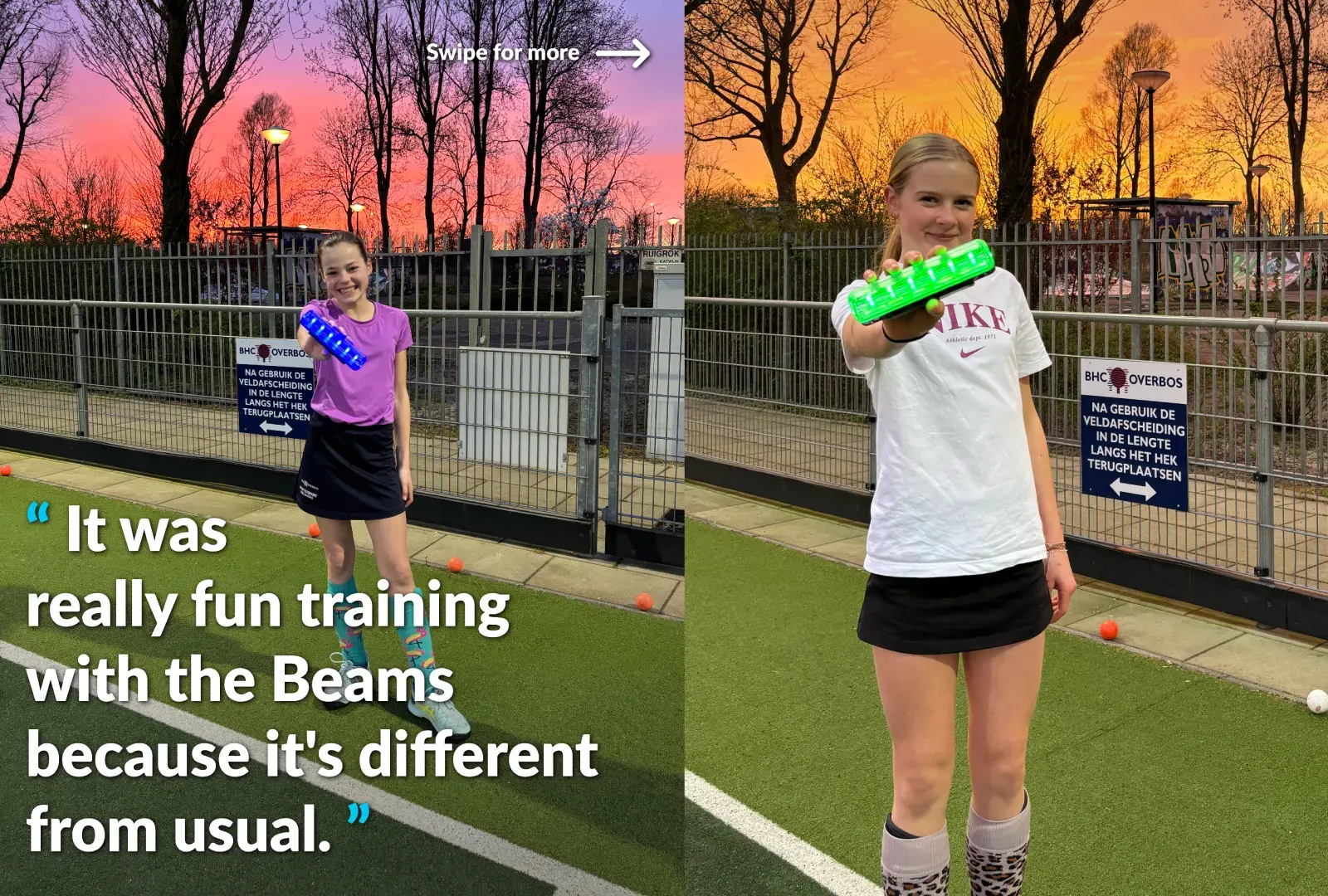
At BHC Overbos MO14-1, X-Skills was used as part of a thesis project by Isabell Gahrmann (ALO Amsterdam). The goal: discovering whether training with interactive light signals helps players switch faster and improve their speed of action.
How the research worked
Over eight weeks, 15 players from the MO14-1 selection team trained in two phases:
- Control period (4 weeks): regular training, without X-Skills.
- Intervention period (4 weeks): training courses with X-Skills Beams.
During the intervention period, a circuit was set out with various X-Skills exercises:
🔹 Individual challenges — dribble and pass on light signals
🔹 Training together — duos that kept each other sharp
🔹 Battles — short, intensive challenges with a competition element
The Beams provided constantly changing incentives. That meant that the players had to react and make decisions over and over again, just like in a real competition situation.
What happened on the field?
The players were enthusiastic, focused and more active than during regular training sessions. They wanted to improve their own scores, challenge each other and noticed for themselves that their response speed improved.
🎙️ “It helps me respond faster!” — Evy, MO14-1
🎙️ “It improves your technique and you learn how to switch better. It's also nice that you can vary.” — Lois, MO 14-1
🎙️ “With the times, it looked like a competition. Super fun and challenging!” — Lana, MO14-1
For the trainer, it was a breath of fresh air: part of the group was able to train independently and in a structured way with X-Skills, while they and the rest of the team were able to focus on other exercises.
Results and insights
The measurements showed that no significant improvement the speed of action was visible compared to the control period. Nevertheless, the practice provided valuable insights:
- More motivation and engagement — the players had visibly more fun
- Higher focus — the light signals forced immediate action
- Variation and gaming experience — exercises felt playful and challenging
- Trainer relieves — players worked independently, with less explanation needed
Why this works
The strength of X-Skills is in line with theoretical insights:
- Implicit learning — players adjust their moves automatically without much explanation
- Dynamic learning environment — changing incentives force you to switch flexibly, just like in competitions
This creates a learning environment that is both challenging and fun, and where players improve their skills unnoticed.
Conclusion
The study at Overbos showed that X-Skills does more than just add light signals. It increases the energy, motivation and independence of players and gives coaches space to guide their team more efficiently.
Although the measurement results were limited, practice proves that X-Skills can be a valuable addition to traditional hockey training.
Also read


This is how a perfect season starts: the Klein Zwitserland kick-off with X-Skills
Read article
Extra training, but with a twist: Hockey5’s x X-Skills at MHC Alkmaar
Read article